










Why Do Golf Balls Have Dimples?
Posted by Tayte Andruss on Jun 16th 2026
If you have ever picked up a ball at the tee and wondered why golf balls have dimples instead of being smooth, the answer comes down to aerodynamics. Those tiny indentations reduce drag, generate lift, and stabilize flight, helping the ball travel nearly twice as far as a smooth ball of the same size and weight. Below, we cover the physics, the history, and what it all means for your game.
The Short Answer: What Do the Dimples on a Golf Ball Do
In a single sentence, golf ball dimples make the ball fly farther and straighter by manipulating the air flowing around it. Specifically, they do three things:
- Reduce drag by roughly 50 percent compared with a smooth sphere.
- Increase lift when the ball spins, through the Magnus effect.
- Stabilize the flight so the ball follows a predictable trajectory.
A dimpled ball can carry close to twice the distance of a smooth ball with identical mass. That is the reason every regulation ball is covered in them.
The Aerodynamics: How Dimples Actually Work
To understand why golf balls are dimpled and not smooth, we have to look at the thin layer of air that hugs the ball during flight. This layer is called the boundary layer, and it decides almost everything about how far the ball travels.
The Boundary Layer and Why Smooth Balls Lose Distance
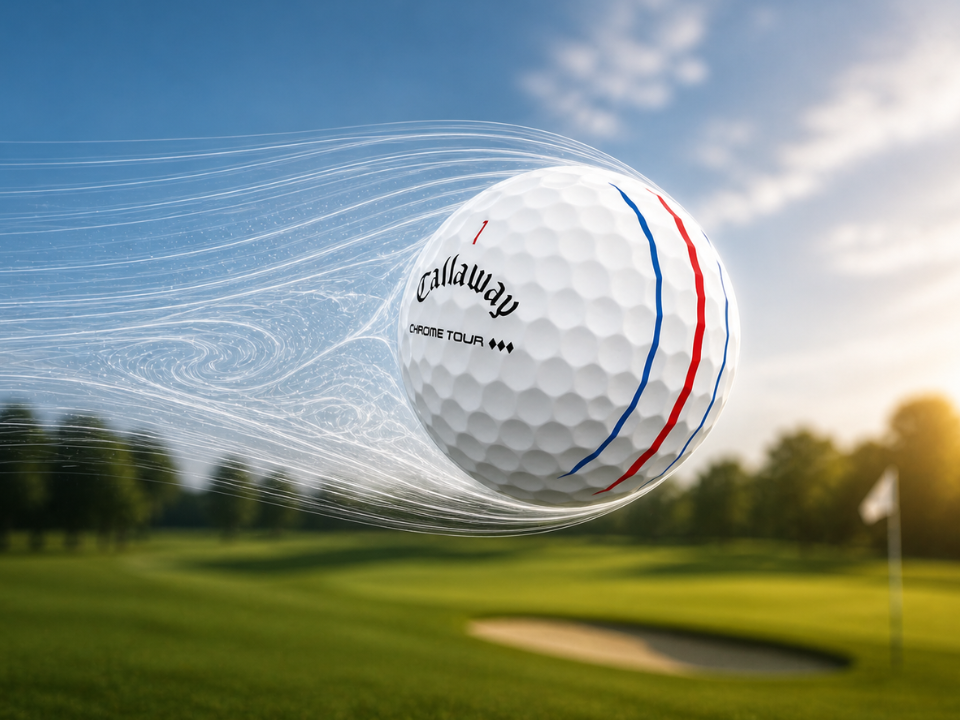
When a perfectly smooth sphere flies through the air, the boundary layer flows along the surface for a short distance and then peels away early, at roughly 82 degrees around the ball. This early separation creates a large, swirling wake behind the ball. That wake is the main source of pressure drag, and pressure drag is what kills distance.
How Dimples Trip the Boundary Layer
Each small indentation creates tiny pockets of turbulence in the boundary layer. Counterintuitive as it sounds, that controlled turbulence is exactly what you want. The turbulent layer carries more energy than a laminar layer, so it clings to the ball's surface much longer, separating closer to 110 to 120 degrees. The result is a wake that is roughly half the size of a smooth ball's wake. A smaller wake means less pressure drag, which means more carry distance.
Lift, Backspin, and the Magnus Effect
Drag reduction is only half the story. The dimples in golf ball construction also help generate lift when the ball spins. When you strike the ball with a clubface that has loft, it leaves with backspin, often around 2,500 to 3,000 rpm with a driver. As the spinning, dimpled surface rotates, it drags air faster across the top of the ball than the bottom. Bernoulli's principle states that air that moves more quickly exerts less pressure. The Magnus effect is an upward lift force produced by the pressure differential between the top and bottom.
This is why a well-struck shot does not follow a simple parabola. It climbs, plateaus near the apex, then drops, because lift is fighting gravity for most of the flight.
Drag Reduction by the Numbers
A few often-cited figures help frame the impact:
- A dimpled ball can have up to 50 percent less drag than a smooth sphere of the same diameter.
- In perfect circumstances, a dimpled ball can travel about four times farther than a smooth one, according to Scientific American.
- In typical playing conditions, the practical distance gain is closer to 1.6 to 2 times that of a smooth ball.
A Brief History: When Did Golf Balls Get Dimples
The reason why there are dimples on a golf ball today comes from a happy accident more than 150 years ago.
- The featherie era before the 1850s. Balls were originally made of leather pouches filled with boiled feathers. They were smooth, expensive, and fragile.
- 1848, the gutta-percha ball. The "gutty," made from hardened tree sap, was cheaper and more durable. Originally smooth, gutties were noticed to fly farther after being scuffed and nicked from use.
- 1898, the Haskell ball. Coburn Haskell's rubber-core design unlocked even more distance.
- In 1905, the first dimple patent was issued. English engineer William Taylor patented a recessed-dimple pattern, formalizing the design and replacing the older bramble (raised-bump) pattern.
- 20th and 21st centuries. Manufacturers refined dimple geometry through wind-tunnel testing and, more recently, computational fluid dynamics simulations.
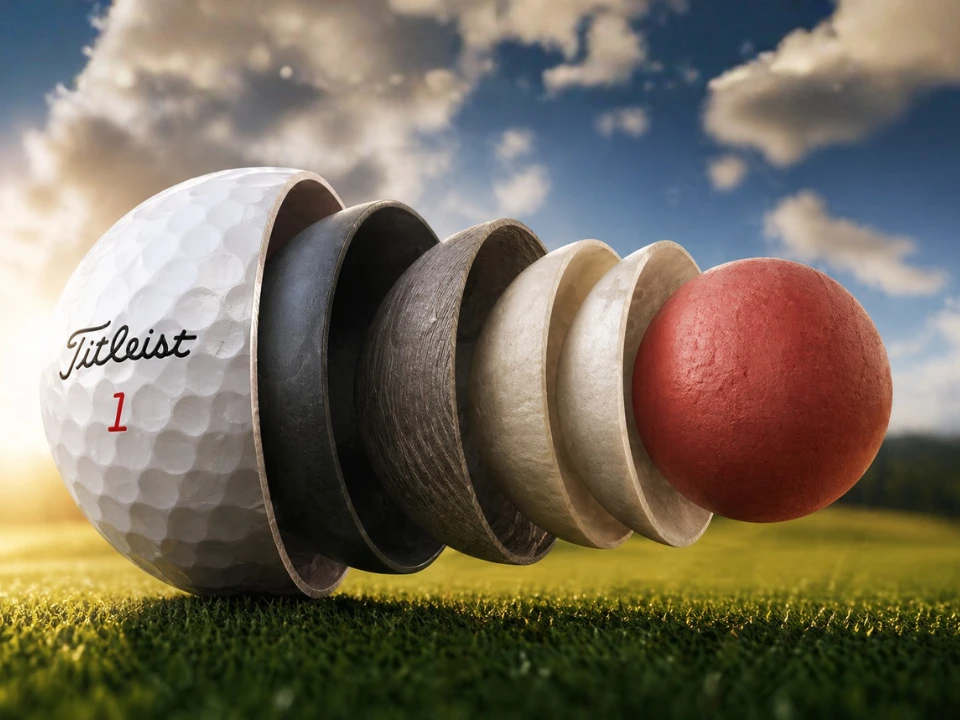
What started as a lucky observation on a 19th-century course is now a precisely engineered feature. To dig deeper into the modern engineering side, see our guide on what golf balls are made of.
How many dimples does a golf ball have?
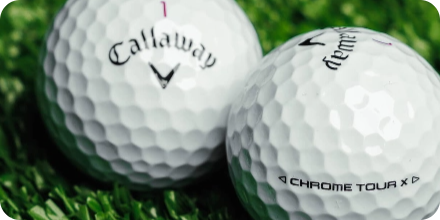
Dimples on a golf ball, how many you find on a given model varies by brand and design, but most modern balls have between 300 and 500. There is no required number under USGA or R&A rules. The only requirement is that the dimple pattern be spherically symmetrical.
Some representative dimple counts:
|
Ball Model |
Approx. Dimple Count |
|
388 |
|
|
332 |
|
|
322 |
|
|
330 |
|
|
338 |
Fun fact: the record for the most dimples on a single ball is reportedly 1,070, divided across multiple sizes.
Do Dimple Shape and Pattern Matter
Yes, while the count gets the headlines, the shape, depth, edge angle, and coverage of each indentation matter just as much.
- Circular dimples are the most common. They are easy to mold consistently and balance lift and drag well.
- Hexagonal dimples (most famously on certain Callaway models) tile together with almost no flat space between them, which can improve aerodynamic efficiency.
- Dual-radius and tear-drop shapes appear on premium balls aimed at fine-tuning trajectory.
- Deeper dimples tend to produce a lower, more penetrating ball flight and are often paired with high-spin balls.
- Shallower dimples tend to keep the ball in the air longer, helpful for slower swing speeds.
What Are These Indentations Called
Just dimples, you will sometimes see "indentations" in engineering papers, and some golfers casually say "divots," but the accepted term across the industry is dimple. So if a friend asks what those things all over the ball are, you can confidently say dimples in a golf ball.
Smooth Ball vs. Dimpled Ball: The Distance Difference
|
Property |
Smooth Ball |
Dimpled Ball |
|
Boundary layer |
Laminar, separates early |
Turbulent, separates late |
|
Wake size |
Large |
About half the size |
|
Drag coefficient (typical) |
~0.45 |
~0.23 |
|
Carry distance (driver) |
~125 m / 137 yds |
~250 to 275 m / 275 to 300 yds |
|
Trajectory shape |
Short parabola |
Climb, plateau, drop |
The takeaway: without dimples, even a Tour-level swing would deliver short results. That single comparison sums up why golf balls have dimples in modern design. If you want to maximize the distance gains those dimples offer, learning the right technique helps too — check out our guide on how to hit a golf ball.
Are There Rules About Dimples
Yes, although they are minimal. The USGA and R&A require that a conforming ball be spherically symmetrical. This rule was tightened in 1981 after the Polara ball used asymmetric patterns to self-correct hooks and slices. Within the symmetry rule, manufacturers are free to vary dimple count, shape, and depth as they see fit.
What This Means for Your Game
You do not need to memorize Reynolds numbers to use this knowledge in the course:
- A higher swing speed often pairs well with lower-spinning balls that have shallower dimples for a flatter flight. Browse our distance golf balls collection for options engineered for exactly this.
- A moderate or slower swing speed often benefits from balls designed to launch higher with more consistent lift.
- Modern dimple patterns are tuned for specific player profiles, so picking a ball that matches your speed and spin tendencies matters more than chasing a specific dimple count.
At Embers Golf, we curate balls from leading brands so you can find a model whose design and overall construction match your game.
Frequently Asked Questions
Why Are Golf Balls Not Smooth, But Have Dimples?
Dimples reduce aerodynamic drag by about 50 percent and add lift through the Magnus effect, letting the ball travel close to twice as far as a smooth ball.
Why Does The Surface Of A Golf Ball Have Dimples?
A smooth ball causes the boundary layer of air to separate early, producing a large wake and high drag. Dimples force a thin, turbulent layer that clings to the ball longer, shrinking the wake.
How Many Dimples Are On A Regulation Golf Ball?
The majority of contemporary balls have 300–500 dimples. There is no required number under USGA rules, only that the pattern be spherically symmetrical.
Why Are There Dimples On Golf Balls Of Different Shapes?
Manufacturers use circular, hexagonal, dual-radius, and other shapes to fine-tune lift, drag, and ball flight characteristics for specific player profiles.
Who Invented Dimples On Golf Balls?
English engineer William Taylor patented the first recessed-dimple design in 1905, after decades of golfers noticing that scuffed gutta-percha balls flew farther than smooth ones.
Why Does A Golf Ball Have Dimples That Vary In Depth?
Depth is one of the levers manufacturers use to control trajectory. Deeper dimples generally produce a lower flight, while shallower dimples help the ball stay in the air longer.
Final Takeaway
The short answer to why golf balls have dimples is that more than a century of physics and engineering has shown those tiny indentations are the single most important reason a golf ball can fly the distances we expect today. They cut drag, generate lift, and keep flight stable.
Curious to see how different dimple designs feel on the face? Browse the curated selection of premium balls at Embers Golf and find the model that fits your swing.
Looking for the best Golf Balls on the course? Check out our full collection of Golf Balls to find the perfect match for your swing speed and playing style. If you need help choosing, our expert team at Embers Golf is here for you! Contact us by Call at 303-800-5659 or email info@embersgolf.com for personalized advice. Don't forget to visit our blog for useful tips, gear recommendations, and insights on golf accessories.